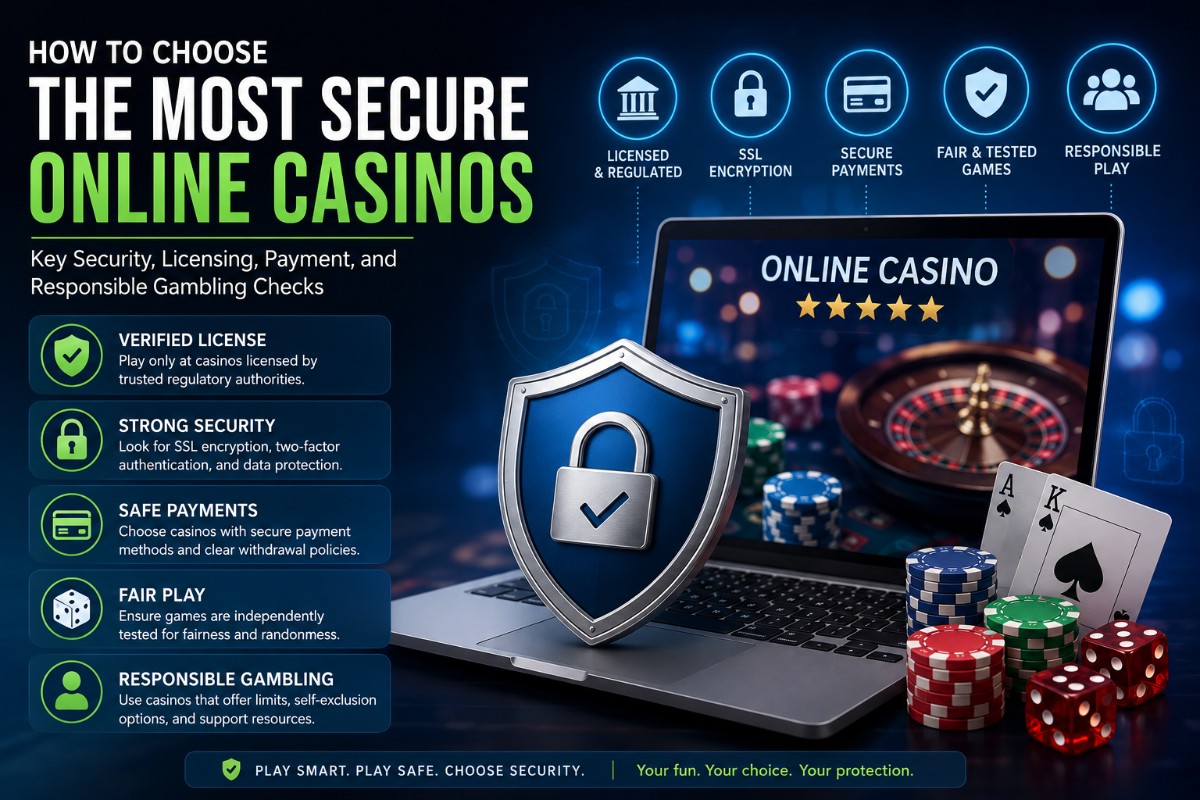
Choosing an online casino should never begin with the biggest bonus or the flashiest game lobby. Security comes first. The most secure online casinos combine legitimate licensing, strong account protection, responsible payment practices, transparent terms, and meaningful player safeguards.
This guide explains how to identify those qualities without relying on exaggerated promises or attractive advertising. The goal is simple: help readers make informed decisions about online gambling and recognize the warning signs of an unsafe operator.
Because gambling laws differ substantially between countries and regions, readers should also confirm that online gambling is legal where they live and use only operators authorized for their jurisdiction. The World Health Organization (WHO) notes that gambling regulation varies between countries and warns that unlicensed providers can expose consumers to significant regulatory and consumer-protection risks.
Editorial and expert methodology
This article is designed as an educational security guide rather than a promise that any particular casino is risk-free. It was prepared using established cybersecurity and public-health guidance, including information from the WHO and the PCI Security Standards Council. Security claims should always be checked against current licensing records and the operator’s own published policies.
No online casino should be described as completely risk-free. A trustworthy assessment looks at evidence: who regulates the operator, how payments are protected, what information is collected, how accounts are secured, and what protections exist for people who may be vulnerable to gambling-related harm.
Why Security Matters More Than a Big Welcome Offer
A spectacular promotion may look exciting, but it tells you very little about the safety of an online casino.
A secure operator should make important information easy to find. You should be able to identify the legal company behind the website, its licensing authority, applicable terms, available payment methods, privacy information, and procedures for resolving complaints.
The strongest online casino experience is therefore not simply entertaining. It is transparent, controlled, and accountable.
Security is particularly important because online casinos can involve several types of sensitive information, including identity documents, payment information, account credentials, and transaction histories. The PCI Security Standards Council explains that PCI DSS provides baseline technical and operational requirements intended to protect payment-account data.
- Verify the Casino’s License Before Creating an Account
One of the most powerful checks is also one of the simplest: verify the license independently.
Do not rely solely on a casino displaying a regulator’s logo. Visit the relevant regulator’s official website and check whether the operator is actually listed and whether the license covers the services being offered to you.
A credible licensing framework can provide important protections around areas such as:
- Operator identity and accountability
- Consumer complaints
- Financial controls
- Responsible-gambling requirements
- Age and identity verification
- Advertising and promotional rules
- Regulatory enforcement
The WHO specifically identifies effective regulation and enforcement of gambling providers as important elements of reducing gambling-related harm.
A license does not mean that every experience will be perfect, nor does it guarantee that you will win. It means there is an identifiable regulatory framework behind the operator.
- Look for Strong Account Security
Your casino account can contain valuable personal and financial information, so account protection deserves serious attention.
Look for an operator that supports features such as:
- Strong password requirements
- Two-factor or multi-factor authentication where available
- Login notifications
- Secure account recovery
- Device or session management
- Clear procedures for reporting suspicious activity
NIST cybersecurity guidance emphasizes the importance of multi-factor authentication and notes that phishing-resistant authentication methods can provide stronger protection than some traditional one-time codes or SMS-based methods.
You can also improve your own security. Use a unique password for your gambling account and never reuse your banking or email password. If multi-factor authentication is offered, enable it.
These simple steps can create a powerful additional barrier against unauthorized access.
- Examine Payment Security Carefully
Payments are one of the most important parts of choosing the most secure online casinos.
A reputable operator should clearly explain how deposits and withdrawals work. Before making a payment, check:
- Which payment providers are supported
- Whether transaction fees are disclosed
- Minimum and maximum transaction amounts
- Expected withdrawal procedures
- Identity-verification requirements
- Any applicable processing times
- Whether payment information is handled directly or through a third-party processor
PCI DSS is an established payment-security standard designed to protect payment-account information. PCI guidance also describes strong cryptography during transmission as an important security control.
Importantly, do not assume that a website is secure simply because it displays a padlock in your browser. HTTPS protects information transmitted between your browser and the website, but it does not prove that the casino itself is legitimate, licensed, financially reliable, or fair.
- Read the Privacy Policy Before Sharing Sensitive Information
Identity verification is common in regulated online gambling. A casino may legitimately request information to verify your identity, age, location, or payment method.
That does not mean you should upload documents without understanding why they are required.
A strong privacy policy should explain:
- What information is collected
- Why it is collected
- How it is used
- How long it may be retained
- Whether information is shared with service providers
- How you can contact the operator about privacy matters
Be particularly cautious if a website requests unusually sensitive information without explaining the reason.
The safest approach is to provide only information required by the operator’s legitimate verification process and to make sure you are communicating through the official website or application.
- Check Whether Games Are Independently Tested
Security is not only about protecting your account. It is also about confidence in the games themselves.
Where applicable, look for information about independent testing, game certification, or recognized testing laboratories. The casino should explain how its games are tested for technical integrity and whether random-number systems are independently assessed.
Avoid websites that make extraordinary claims such as “guaranteed wins,” “secret winning systems,” or “risk-free jackpots.” These statements should immediately raise skepticism.
A secure casino can offer exciting games without promising impossible outcomes.
- Read the Terms and Conditions Before Accepting a Bonus
Bonuses can be attractive, but they are also one of the areas where inexperienced players can misunderstand the real conditions.
Before accepting an offer, check:
- Wagering requirements
- Eligible games
- Maximum bet restrictions
- Maximum winnings, if any
- Deposit requirements
- Expiration dates
- Withdrawal conditions
- Rules for cancelling a bonus
The most secure online casinos should make these conditions reasonably accessible rather than hiding important restrictions behind complicated wording.
A valuable rule is simple: if you cannot explain the promotion in your own words, do not accept it yet.
Taking a few minutes to understand the terms can prevent unpleasant surprises later.
- Look for Serious Responsible-Gambling Tools
This is an essential part of security that is sometimes overlooked.
A responsible operator should provide practical tools that can help players control their activity. Depending on the jurisdiction and operator, these may include:
- Deposit limits
- Loss limits
- Time limits
- Reality checks
- Cooling-off periods
- Self-exclusion
- Account restrictions
- Links to support organizations
The WHO recommends measures such as binding limits, effective self-exclusion, and product-safety measures as part of efforts to reduce gambling harm.
These features are not merely administrative extras. They can provide meaningful protection.
The WHO also recognizes gambling disorder as a health condition and reports that gambling can cause financial, psychological, and social harms.
For that reason, responsible gambling should be considered a core part of a trustworthy online casino—not an optional marketing feature.
- Watch for Warning Signs
Some warning signs are remarkably consistent.
Be cautious when a website:
- Has no verifiable license
- Hides its corporate identity
- Uses unclear payment information
- Makes unrealistic winning claims
- Has confusing or contradictory terms
- Pressures you to deposit immediately
- Makes withdrawals unusually difficult
- Provides poor or evasive customer support
- Requests unexplained sensitive information
- Has no meaningful responsible-gambling tools
One warning sign may deserve investigation. Several together are a powerful reason to leave.
Trustworthy operators do not need to manufacture urgency. They can explain their rules clearly and allow customers to make informed choices.
- Evaluate Customer Support Before You Need It
Customer support is another useful test.
Before depositing money, try contacting support with a straightforward question. See whether the response is clear, professional, and consistent with the published terms.
Check whether the casino provides:
- Live chat
- Email support
- A help center
- Complaint procedures
- Responsible-gambling assistance
- Clear operating hours
Excellent customer support cannot compensate for missing licensing or weak security, but poor support can reveal deeper problems.
10. Protect Yourself From Phishing and Fake Casino Websites
Even a legitimate casino can be impersonated by criminals.
Never assume that a search result is automatically authentic. Check the domain carefully before entering passwords or payment information. Avoid clicking suspicious promotional messages or unsolicited links.
NIST’s cybersecurity guidance emphasizes stronger authentication as an important defense against account compromise and phishing threats.
A useful habit is to navigate directly to the operator’s verified website rather than entering sensitive information through an unexpected link.
Also avoid downloading unofficial casino applications or browser extensions. Use only software distributed through legitimate channels.
11. Consider Your Own Gambling Limits
The most secure online casinos cannot eliminate every gambling risk. Personal financial boundaries remain important.
Decide your spending limit before playing and treat gambling as entertainment rather than a method of earning income. Never use money needed for rent, food, education, debt payments, or essential household expenses.
Do not chase losses. A previous loss does not make a future win more likely.
The WHO reports that gambling harm can include financial distress and that harmful gambling can affect people beyond the individual gambler.
If gambling stops feeling recreational or begins interfering with everyday responsibilities, stepping away is a smart decision—not a failure.
12. Build a Simple Security Scorecard
You do not need complicated software to compare online casinos.
Create a short checklist and assess each operator:
License: Can the license be independently verified?
Company: Is the legal operator clearly identified?
Payments: Are deposit and withdrawal procedures transparent?
Privacy: Is there a clear privacy policy?
Account security: Are strong authentication options available?
Game integrity: Is independent testing or certification explained?
Terms: Are bonus and withdrawal conditions understandable?
Player protection: Are meaningful responsible-gambling tools available?
Support: Can you reach a real support team?
Reputation: Are there credible, independent sources discussing the operator?
A casino that performs strongly across these categories deserves more consideration than one that simply offers the largest promotion.
Frequently Asked Questions
What are the most secure online casinos?
There is no universal list that remains correct forever. The safest approach is to choose a legally authorized operator in your jurisdiction and independently verify its current license, security practices, payment procedures, privacy policy, and responsible-gambling protections.
How can I tell whether an online casino is legitimate?
Start by verifying its license with the relevant gambling regulator. Then confirm the legal company name, payment information, privacy policy, terms and conditions, customer-support channels, and responsible-gambling tools.
Are online casinos completely safe?
No online gambling service should be described as completely risk-free. Technical, financial, privacy, and gambling-related risks can never be reduced to zero. The objective is to choose an operator with strong safeguards and to use the service responsibly.
Is a casino license enough to prove security?
No. Licensing is an important starting point, but you should also examine payment protection, account security, privacy practices, game testing, withdrawal terms, and responsible-gambling measures.
Should I use a casino that asks for identity verification?
Identity verification can be a normal feature of regulated gambling and may be required for age, identity, location, or anti-fraud checks. Before submitting documents, verify that you are dealing with the legitimate operator and understand why the information is being requested.
What payment-security standard should I look for?
PCI DSS is a major industry standard covering the protection of payment-account data. The PCI Security Standards Council describes it as a baseline of technical and operational requirements for protecting payment information.
Why are responsible-gambling tools important?
They provide practical ways to control gambling activity. The WHO identifies measures such as binding limits and self-exclusion as important approaches for preventing and reducing gambling-related harm.
What should I do if an online casino makes me uncomfortable?
Stop depositing, avoid providing additional sensitive information, preserve relevant account records, and contact the appropriate regulator or payment provider when appropriate. If gambling itself is becoming difficult to control, consider using self-exclusion or other support services.
Final Verdict: Security Is the Real Winning Choice
Choosing the most secure online casinos is not about finding the loudest promotion or the most spectacular game library. It is about finding evidence of legitimacy, accountability, technical protection, transparent payments, privacy safeguards, fair practices, and responsible-gambling support.
The strongest choice is the casino that makes security easy to understand.
Before you sign up, verify the license. Before you deposit, read the payment and withdrawal rules. Before you play, understand the bonus conditions. And throughout your experience, keep firm limits on both time and money.
That approach creates something more valuable than excitement alone: confidence.
A secure online casino should earn your trust through transparent evidence—not demand it through advertising.
*This article is educational information, not financial, legal, or medical advice. Gambling laws and licensing requirements vary by jurisdiction. Only gamble where it is legal, only if you meet the applicable age requirement, and use responsible-gambling controls whenever appropriate. The WHO identifies gambling as a potential source of significant health and social harm for some people and recommends strong regulatory and preventive measures. *