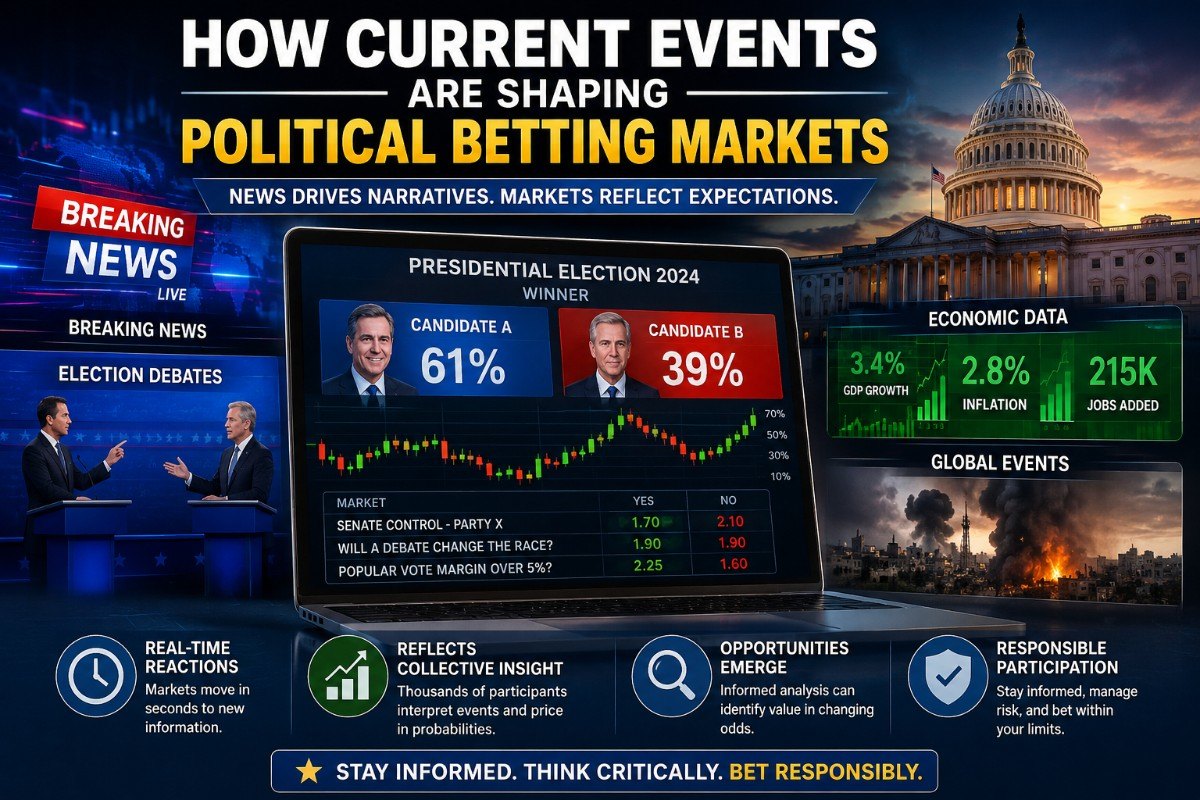
Political betting markets have become one of the most fascinating ways to observe how people respond to major events. Elections, leadership contests, debates, economic data, international developments, court rulings, and unexpected announcements can all trigger rapid changes in market expectations.
The key to understanding these markets is simple: odds react to information, but information is not the same as certainty.
For readers interested in political betting markets, current events create a constantly changing environment. A candidate may gain momentum after a strong debate. An economic report may reshape perceptions of an incumbent government. A legal development may alter expectations surrounding an election. International events can quickly move public attention from domestic policy to national security, energy, trade, or diplomacy.
That makes political markets exciting to watch—but also challenging to interpret responsibly.
This guide explains how current events influence political betting markets, why prices can change so quickly, and how readers can evaluate political information with greater discipline.
Political Betting Markets Reflect Changing Expectations
Political betting markets generally attempt to express collective expectations about future political outcomes. Prices or odds may change when participants believe that new information affects the probability of a particular result.
For example, a major event might influence expectations about:
- Election winners
- Party control of a legislature
- Leadership contests
- Cabinet appointments
- Referendums
- Policy outcomes
- International agreements
- Political resignations or appointments
The most important concept is that a market price is not a guarantee or official prediction. It is a moving estimate shaped by the participants, available information, liquidity, trading activity, and rules of the specific market.
A sudden move can therefore be meaningful without proving that an outcome is certain.
This distinction is essential for anyone following political betting markets. The strongest approach is to treat odds as one source of information rather than the final answer.
Breaking News Can Create Instant Market Reactions
Breaking news is one of the most powerful forces affecting political betting markets.
Markets may react within minutes when credible reports emerge about an important development. However, early reactions can also be volatile because the complete facts may not yet be known.
A headline may initially suggest a dramatic political shift. Later reporting may provide additional context that changes the interpretation. As a result, odds can move sharply in one direction and then reverse.
This creates an important lesson:
Speed is valuable, but accuracy is more valuable.
Readers should consider several questions before drawing conclusions from a sudden market movement:
- Is the original information confirmed?
- Is the source reliable?
- Does the event directly affect the political outcome being traded?
- Is the market reaction proportionate to the new information?
- Have other credible sources provided additional context?
Political betting markets reward careful interpretation more than emotional reactions. A dramatic headline can create excitement, but disciplined analysis helps separate temporary noise from meaningful change.
Election Debates Can Reshape Perceptions
Debates remain major political events because they provide a highly visible opportunity for candidates to communicate directly with voters.
A strong performance may improve perceptions of competence, confidence, preparation, or leadership. A weak performance may create new doubts. Yet debate reactions are often more complicated than immediate headlines suggest.
Political betting markets may move during or immediately after a debate because participants react to:
- Candidate performance
- Unexpected statements
- Policy clarity
- Communication style
- Media coverage
- Post-debate analysis
- Public reaction
The challenge is that instant reactions can differ from longer-term effects.
A candidate may receive intense attention after a memorable moment without experiencing a lasting change in voter support. Conversely, a debate performance that initially receives limited attention may gradually influence public opinion.
For that reason, political betting markets are most useful when examined alongside multiple forms of evidence, including credible polling, election fundamentals, historical context, and verified reporting.
Economic Events Often Carry Powerful Political Consequences
Economic conditions frequently play an important role in political expectations.
Inflation reports, employment figures, interest-rate decisions, growth data, energy prices, and consumer confidence can all influence the political environment. Voters may judge governments partly through their experiences with the economy, although political behavior is influenced by many factors beyond a single economic indicator.
When significant economic news is released, political betting markets may react because participants attempt to estimate its possible consequences.
For example, markets may consider whether an economic development could affect:
- Approval ratings
- Campaign messaging
- Government credibility
- Voter priorities
- Policy debates
- Incumbent advantages
However, one data release rarely determines an entire election.
A strong analytical approach considers trends rather than isolated numbers. It also recognizes that economic statistics require context. A single monthly report may later be revised, and different groups may experience the economy differently.
This is why careful readers should avoid turning every economic headline into a sweeping political conclusion.
Polls and Political Betting Markets Can Influence Each Other
Opinion polls and political betting markets are often discussed together, but they measure different things.
A poll typically attempts to estimate public opinion within a defined sample and methodology. A betting market reflects the prices and expectations created by market participants.
Neither should automatically be treated as infallible.
Scientific survey research has established methods for reducing uncertainty, including probability sampling, weighting, measurement design, and statistical estimation. At the same time, all polling contains uncertainty, including sampling error and potential methodological limitations.
Markets also have limitations. Prices can be influenced by participant behavior, available liquidity, new information, market structure, and temporary enthusiasm.
The most useful approach is therefore to compare evidence.
When polls, economic conditions, historical patterns, expert analysis, and political betting markets point in a similar direction, confidence in a broad trend may increase. When they disagree, that disagreement can be valuable information in itself.
It may indicate uncertainty, methodological differences, or an event that has not yet been fully understood.
Global Events Can Dramatically Change the Political Conversation
International events can quickly transform domestic politics.
Wars, diplomatic crises, trade disputes, energy disruptions, migration developments, public health emergencies, and major financial events can shift the public agenda. Issues that seemed secondary may suddenly become central.
Political betting markets may react because participants attempt to assess how these developments could influence leadership, voter priorities, government decisions, or international relationships.
Yet geopolitical events are especially difficult to predict.
Information can change rapidly. Early reports may be incomplete. Governments may respond in unexpected ways. Events that initially appear politically damaging may fade quickly, while smaller developments can grow into major controversies.
The most responsible approach is to recognize uncertainty rather than pretend that every breaking event has a clear political meaning.
Court Decisions and Legal Developments Can Move Markets
Legal developments can also influence political betting markets, particularly when they involve major candidates, election procedures, constitutional questions, campaign rules, or government authority.
These events may create significant market movement because they can alter:
- Candidate eligibility
- Campaign schedules
- Media attention
- Political messaging
- Public perceptions
- Institutional processes
However, legal reporting requires particular care.
A court decision may be appealed. A ruling may have a narrower effect than early headlines suggest. Legal experts may disagree about future consequences.
Before reacting to legal news, readers should examine the actual decision when available and rely on credible reporting that explains what changed—and what did not.
Precision is more powerful than speculation.
Why Political Betting Markets Can Overreact
Fast-moving markets are not always perfectly calm or perfectly efficient.
A sudden wave of attention can attract participants who are responding to the same dramatic news. Limited liquidity may amplify price changes. Social media can accelerate emotional reactions before complete information is available.
This can produce overreactions.
Common causes include:
- Misleading headlines
- Unverified reports
- Viral social media content
- Confusion about market rules
- Emotional responses
- Low-liquidity trading
- Misinterpretation of polls or data
For readers, this means that a dramatic change in odds should trigger curiosity—not automatic confidence.
Ask what specifically caused the movement. Then examine whether the underlying evidence supports the size of the reaction.
Social Media Has Accelerated Political Information
Social platforms have changed how quickly political information travels.
A short video, viral statement, leaked document, or influential post can reach millions of people within hours. Political betting markets may react before traditional reporting has fully investigated the claim.
This creates both opportunity and risk.
Fast information can help markets incorporate new developments quickly. But misinformation can spread with similar speed.
The best defense is verification.
Readers should prioritize:
- Original documents when available.
- Reputable news organizations.
- Official statements and records.
- Multiple independent sources.
- Context from qualified experts.
A viral post may be interesting. It is not automatically reliable evidence.
A Smarter Framework for Reading Political Betting Markets
Anyone following political betting markets can benefit from a simple framework.
1. Identify the Event
What actually happened?
Avoid beginning with commentary. Start with the verified event itself.
2. Measure the Market Reaction
How large was the change?
A small movement may simply reflect normal activity. A major movement deserves closer investigation.
3. Search for the Cause
Was the movement connected to a poll, debate, economic report, court decision, international event, or other development?
4. Check the Evidence
Look beyond a single headline. Compare credible sources and examine the strength of the available information.
5. Consider Alternative Explanations
Could the market have moved because of liquidity, rumors, temporary enthusiasm, or unrelated events?
6. Respect Uncertainty
Even a well-supported expectation can be wrong.
This framework can help readers approach political betting markets with greater confidence while avoiding the false certainty that often accompanies dramatic news.
Responsible Participation Should Always Come First
Political betting involves financial risk and may not be legal or available in every location. Laws, regulations, platform rules, and eligibility requirements vary.
Anyone considering participation should first understand the legal framework where they live and carefully review the rules of the specific platform.
Responsible participation includes:
- Setting a strict spending limit
- Avoiding attempts to recover losses
- Understanding market settlement rules
- Never treating odds as guarantees
- Taking breaks when emotions become intense
- Avoiding decisions made under pressure
Political events can be emotionally charged. Combining strong personal beliefs with financial decisions can increase the risk of impulsive behavior.
The most sustainable mindset is simple: protect your judgment before protecting your prediction.
How Trustworthy Political Content Should Be Created
High-quality information about political betting markets should be created with clear editorial standards.
A trustworthy article should distinguish between:
- Verified facts
- Market data
- Analysis
- Opinion
- Uncertainty
The author or editorial team should explain the purpose of the content: to help readers understand how events and information can influence political markets, rather than to promise guaranteed outcomes.
Expert review can strengthen accuracy, particularly for complex topics involving statistics, polling methodology, economics, law, or political institutions.
For the strongest reader experience, content should also be reviewed and updated when important facts change. Secure website technology, transparent editorial practices, and clear distinctions between information and promotion can further support trust.
The Future of Political Betting Markets
Political information is becoming faster, more global, and more data-driven.
Real-time reporting, social platforms, polling models, public data, and digital markets are creating a political environment where expectations can change rapidly.
The future may bring more sophisticated tools for interpreting probability, uncertainty, and changing public information. Yet technology cannot remove uncertainty from politics.
Unexpected events will continue to happen.
That uncertainty is precisely why political betting markets remain so dynamic. They offer a constantly changing snapshot of expectations—but the most valuable skill is not predicting every move.
It is learning how to think clearly when everyone else is reacting quickly.
Frequently Asked Questions
What causes political betting odds to change?
Political betting odds can change when new information affects participant expectations. Common triggers include polls, debates, economic reports, legal decisions, major news events, candidate announcements, and international developments.
Are political betting markets more accurate than polls?
They measure different things. Polls estimate public opinion using survey methodologies, while markets reflect participant expectations and market activity. Comparing multiple sources of evidence is generally more informative than relying entirely on one measure.
Can breaking news create false market signals?
Yes. Early reports may be incomplete or incorrect, and emotional reactions can produce temporary price movements. Verification and context are essential.
How do economic reports affect political betting markets?
Economic information can influence expectations about voter priorities, government performance, campaign narratives, and incumbent support. However, individual reports should be viewed within broader economic and political trends.
Do debates have a lasting effect on political markets?
Sometimes, but not always. Immediate reactions can be dramatic, while longer-term effects depend on continued media coverage, voter perceptions, subsequent events, and broader campaign conditions.
What is the best way to interpret political betting markets?
Treat market prices as one source of information. Compare them with credible reporting, polling, historical context, economic data, and verified developments.
Are political betting markets guaranteed predictions?
No. Political markets involve uncertainty. Prices represent changing expectations and can be wrong. No market movement should be interpreted as a guarantee of an election result or political outcome.
Why is responsible participation important?
Political betting involves financial risk, and political events can trigger strong emotions. Clear limits, careful research, and an understanding of uncertainty can help reduce impulsive decision-making.
Conclusion: Turn Information Into Insight, Not Overconfidence
Current events are reshaping political betting markets every day. A debate can change perceptions. An economic report can influence political narratives. A court decision can create uncertainty. A global crisis can transform the entire conversation.
For readers following political betting markets, the greatest advantage is not reacting first. It is understanding more.
Stay curious. Verify bold claims. Compare evidence. Respect uncertainty. Focus on meaningful trends instead of every temporary headline.
The political world will continue to deliver surprises. By approaching political betting markets with discipline, critical thinking, and responsible judgment, readers can turn a fast-moving stream of events into clearer, more informed insight.
Author and Editorial Note: This article is designed as an informational overview of how current events can influence political betting markets. It should be reviewed by editors or subject-matter experts with relevant knowledge of political analysis, statistics, economics, or regulated wagering before publication. The purpose is educational: to explain market behavior, uncertainty, and responsible decision-making—not to guarantee outcomes or provide financial advice.