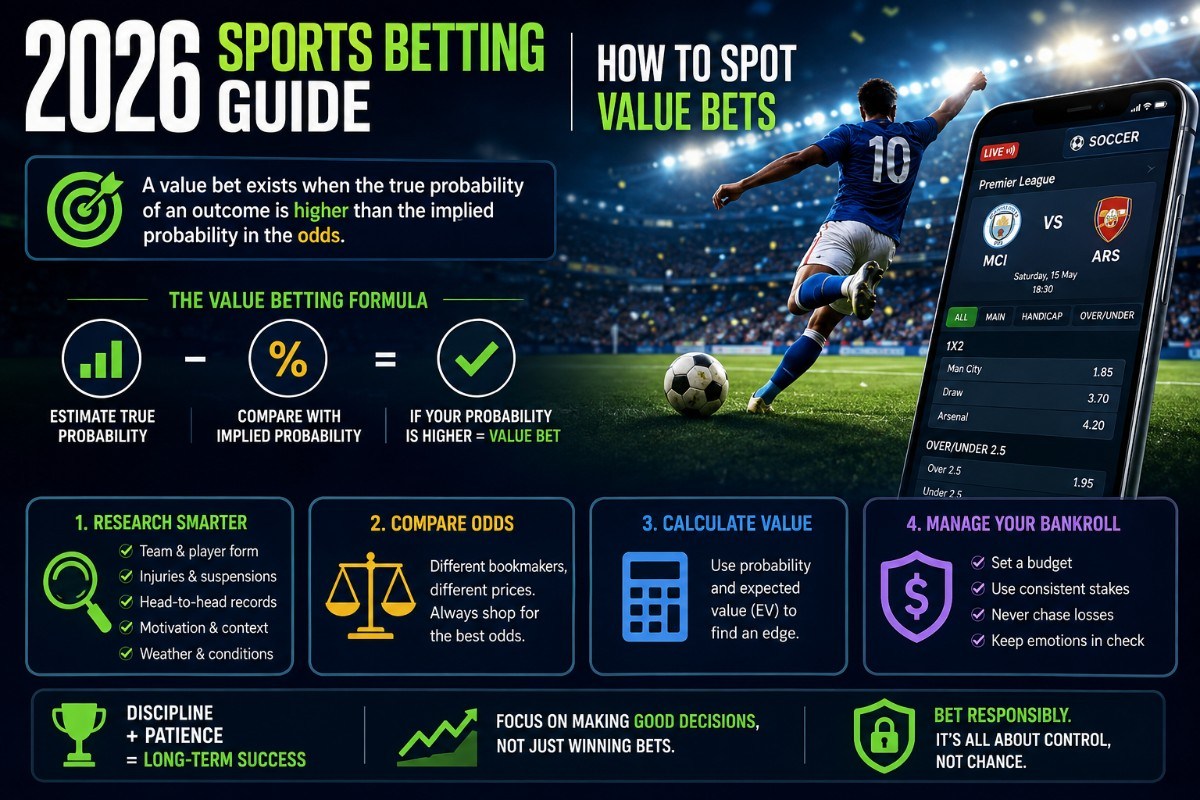
Understanding the Real Meaning of Value Bets
Sports betting is often misunderstood as simply predicting who will win. Successful long-term decision-making is more complex. The key question is not only “Who is most likely to win?” but also “Are the odds better than the probability suggests?”
That is the foundation of a value bet.
A value bet exists when the odds offered imply a probability that is lower than your own reasonable estimate of the actual probability. In simple terms, you may believe an outcome has a stronger chance of happening than the betting price reflects.
This approach does not guarantee that an individual wager will win. Sports contain uncertainty, random events, injuries, tactical changes, and unexpected performances. However, probability-based thinking can help bettors make more informed choices over a large number of decisions.
For readers exploring modern Sports Betting Guide through platforms such as Into88 Sports, understanding value can provide a more disciplined framework than relying only on intuition, favorite teams, or exciting headlines.
The most powerful advantage is often not predicting the future perfectly. It is recognizing when a price may offer better value than expected.
The Crucial Difference Between Odds and Probability
Odds are a price. Probability is an estimate of likelihood.
These two concepts are closely connected, but they are not identical.
For decimal odds, implied probability can be estimated with a simple calculation:
Implied Probability = 1 ÷ Decimal Odds × 100
For example:
- Odds of 2.00 imply a probability of approximately 50%
- Odds of 4.00 imply approximately 25%
- Odds of 1.50 imply approximately 66.7%
Imagine a team is offered at decimal odds of 3.00.
The implied probability is:
1 ÷ 3.00 = 33.3%
If your research suggests that the team has a realistic 40% chance of winning, the price may represent potential value.
This does not mean the team will win. A 40% probability also means losing remains the more common outcome in many individual situations. The important question is whether the price is favorable relative to the estimated probability.
That distinction is essential for anyone trying to understand value betting.
How to Estimate True Probability More Carefully
Estimating probability is the most challenging part of finding a value bet.
A good estimate should consider multiple relevant factors rather than one dramatic statistic.
Team and Player Performance
Start with recent and long-term performance.
Useful questions include:
- How has the team performed over a meaningful sample?
- Are recent results supported by strong underlying performance?
- Have opponents been unusually weak or strong?
- Is a player returning from injury?
- Has the team changed its tactical approach?
One important lesson from statistical reasoning is that small samples can be misleading. A team winning five matches in a row does not automatically mean it has become unbeatable. Likewise, a short losing streak does not necessarily prove that a strong team has suddenly become poor.
Look beyond the headline.
Injuries and Availability
Player availability can significantly affect the expected strength of a team.
However, bettors should avoid assuming that every absence has the same impact. Consider:
- The player’s role
- Available replacements
- Squad depth
- Tactical changes
- Whether the player is returning at full fitness
The goal is not simply to collect injury news. The goal is to estimate how that information changes the actual probability of the outcome.
Motivation and Context
Context can matter.
A late-season match may have very different incentives from an early-season fixture. Tournament scheduling, travel, fatigue, rotation, weather, and rest can all influence performance.
Still, motivation should be used carefully. It is easy to create convincing stories that are difficult to measure.
Strong analysis asks: Can this factor realistically change the probability, or am I simply creating a narrative?
Compare Odds Before Making a Decision
One of the simplest ways to search for value is to compare available prices.
Different sportsbooks may evaluate the same event differently. A small difference in odds can become meaningful over time.
For example:
- Sportsbook A: 2.00
- Sportsbook B: 2.15
Both prices may appear similar. Yet the implied probabilities are different.
At 2.00, the implied probability is 50%.
At 2.15, the implied probability is approximately 46.5%.
If your independent estimate suggests a 50% chance, the second price may offer a stronger opportunity.
This is why experienced bettors often focus on price quality, not simply on selecting the most likely winner.
A favorite can be a poor betting choice if the odds are too short. An underdog can be interesting if the price is significantly higher than its realistic probability suggests.
The winning mindset is not: “Will this definitely happen?”
It is: “Is this price attractive relative to the risk?”
The Powerful Role of Expected Value
Expected value, often called EV, is a mathematical way of evaluating whether a decision may be favorable over repeated situations.
A simplified formula is:
Expected Value = Probability of Winning × Potential Profit − Probability of Losing × Stake
Suppose you estimate a team has a 50% chance of winning.
You find odds of 2.20.
A $100 stake would create a potential profit of $120.
Your simplified expected value calculation would be:
0.50 × $120 − 0.50 × $100 = $10
That does not mean you will earn $10 from the next wager.
Instead, it means that if your probability estimate is accurate and the same conditions could be repeated many times, the mathematical expectation may be positive.
This is where discipline becomes extremely important.
Value betting is based on repeated decision quality, not guaranteed short-term results.
Avoid the Most Common Value Betting Mistakes
Mistake One: Confusing Confidence With Value
You may feel extremely confident that a famous team will win.
But confidence alone does not create value.
If the odds imply a 90% probability and you believe the true probability is only 85%, the wager may not offer favorable value despite the team’s high chance of winning.
Always compare your estimate with the market price.
Mistake Two: Chasing Recent Results
A recent winning streak can create excitement, but markets also react to public information.
If everyone sees the same impressive results, the odds may already reflect that performance.
Look for deeper information rather than automatically following the latest trend.
Mistake Three: Ignoring Small Edges
Many bettors search for an obvious mistake in the odds.
In reality, potential value can sometimes be small.
A disciplined approach recognizes that a modest mathematical edge may be more realistic than a dramatic “sure win.”
Mistake Four: Increasing Stakes After Losses
Losses are part of probability-based betting.
Increasing your stake simply to recover previous losses can quickly increase risk. This behavior is often driven by emotion rather than analysis.
A strong bankroll plan protects you from making desperate decisions.
Bankroll Management: Your Essential Safety Net
Even a well-researched value bet can lose.
For that reason, bankroll management is one of the most important parts of responsible sports betting.
A simple approach is to establish a dedicated entertainment budget and divide it into smaller units.
For example, instead of risking a large percentage of available funds on one prediction, a bettor might use consistent and controlled stake sizes.
The exact method depends on personal circumstances and risk tolerance, but several principles remain useful:
- Never assume a bet is guaranteed.
- Avoid risking money needed for essential expenses.
- Do not chase losses.
- Keep records of decisions and results.
- Review your process over a meaningful number of wagers.
- Take breaks when betting stops being enjoyable or controlled.
Responsible betting should remain entertainment, not a solution to financial problems.
The strongest long-term strategy begins with protecting your ability to make calm, rational decisions.
Build Your Own Value Betting Process
A clear process can reduce emotional decision-making.
Here is a practical framework.
Step 1: Study the Event
Review relevant information such as form, performance data, team news, scheduling, and matchup characteristics.
Avoid collecting unnecessary information. Focus on factors that may genuinely influence probability.
Step 2: Create an Independent Probability Estimate
Before becoming overly influenced by the available odds, make your own estimate.
Ask yourself:
What percentage chance does each realistic outcome have?
Your estimate does not need to be perfect. The goal is to create a reasoned starting point.
Step 3: Convert the Odds Into Implied Probability
Calculate what probability the market price represents.
This allows you to compare your estimate directly with the available odds.
Step 4: Look for a Meaningful Difference
If your estimated probability is higher than the implied probability, there may be potential value.
However, remember that your estimate can also be wrong.
Be humble. A disciplined bettor continuously tests assumptions.
Step 5: Manage Your Stake
Use a consistent staking approach that fits your available bankroll and personal risk tolerance.
Never let excitement override your limits.
Step 6: Record the Decision
Keep a record of:
- Event
- Market
- Odds
- Estimated probability
- Stake
- Reason for the selection
- Final result
Over time, these records can reveal strengths and weaknesses in your analysis.
This is far more useful than judging your entire strategy based on one lucky win or one frustrating loss.
Why Data Can Help—but Cannot Eliminate Uncertainty
Modern sports betting in 2026 gives fans access to enormous amounts of information.
Statistics, performance models, historical databases, and live updates can improve analysis. However, more data does not automatically create better decisions.
Data must be interpreted correctly.
A useful statistic should have context. A team may have excellent possession numbers but struggle to create dangerous chances. A player may score frequently against weak opponents but perform differently against stronger defenses.
The most valuable skill is not simply finding more numbers.
It is asking better questions about those numbers.
Good analysis combines evidence, context, probability, and humility.
That balance can help bettors avoid overconfidence while still searching for genuine opportunities.
How to Recognize a Stronger Betting Environment
Trust matters when choosing where to follow sports markets.
A responsible sports betting experience should prioritize clear information, secure technology, understandable rules, and transparent account processes.
Before using any platform, users should review factors such as:
- Licensing and legal availability in their jurisdiction
- Security practices
- Privacy protections
- Terms and conditions
- Payment procedures
- Responsible gambling tools
- Customer support options
Readers should also verify that betting is legal and age-appropriate where they live.
Transparency is a powerful signal of trust. Clear explanations are generally more valuable than unrealistic promises.
No expert analysis can guarantee profits, and no legitimate guide should claim otherwise.
The Smartest Mindset for Finding Value Bets
The search for value is ultimately a search for better decisions.
You do not need to predict every match correctly.
You do not need a secret system.
You do not need to chase dramatic wins.
Instead, focus on a repeatable process:
Research carefully. Estimate probabilities. Compare odds. Identify potential value. Manage risk. Review results.
That approach may not feel as exciting as chasing a “guaranteed winner,” but it is more disciplined and intellectually honest.
The real thrill comes from understanding the market, testing your analysis, and improving your decision-making over time.
In 2026, sports betting technology may continue to evolve, but the central principle remains powerful:
A good prediction is not automatically a good bet. The price matters.
Learning to recognize that difference can transform the way you evaluate sports betting opportunities.
Frequently Asked Questions
What is a value bet?
A value bet is a wager where you believe the probability of an outcome is greater than the probability implied by the available odds. It does not guarantee a win; it is a probability and pricing concept.
How do I calculate implied probability from decimal odds?
Divide 1 by the decimal odds and multiply by 100.
For example, odds of 2.50 equal:
1 ÷ 2.50 × 100 = 40% implied probability.
Can beginners find value bets?
Yes. Beginners can learn the basic concepts by studying probability, comparing odds, and keeping records. Starting slowly and using small, affordable stakes can help maintain discipline.
Are value bets guaranteed to win?
No. A value bet can lose, and several losing results can occur even when a probability estimate is reasonable. Value describes the relationship between estimated probability and price, not certainty.
Why is bankroll management important?
Bankroll management helps control risk and reduce emotional decision-making. Because individual results are uncertain, responsible stake sizing can help bettors avoid exposing too much money to one outcome.
How often should I compare odds?
Comparing odds before placing a wager can help you understand how different prices affect potential value. Even relatively small differences can matter when decisions are repeated over time.
What is the biggest mistake when looking for value?
One of the biggest mistakes is assuming that being correct about the likely winner automatically means a bet has value. The odds must also justify the risk.
Final Thoughts: Make Every Decision Count
The most effective approach to sports betting is not built on promises of certainty. It is built on knowledge, patience, discipline, and intelligent comparison.
Learning how to spot a potential value bet can help you move beyond emotional predictions and focus on the relationship between probability and price. Research the event, challenge your assumptions, compare the odds, and protect your bankroll.
The goal is simple but powerful:
Make smarter decisions, stay in control, and enjoy the excitement of sport responsibly.
As betting markets continue to develop in 2026, informed users can benefit from a clear process, transparent information, and a commitment to responsible play. The strongest advantage is not a magic formula—it is the confidence that comes from understanding what you are doing and why.