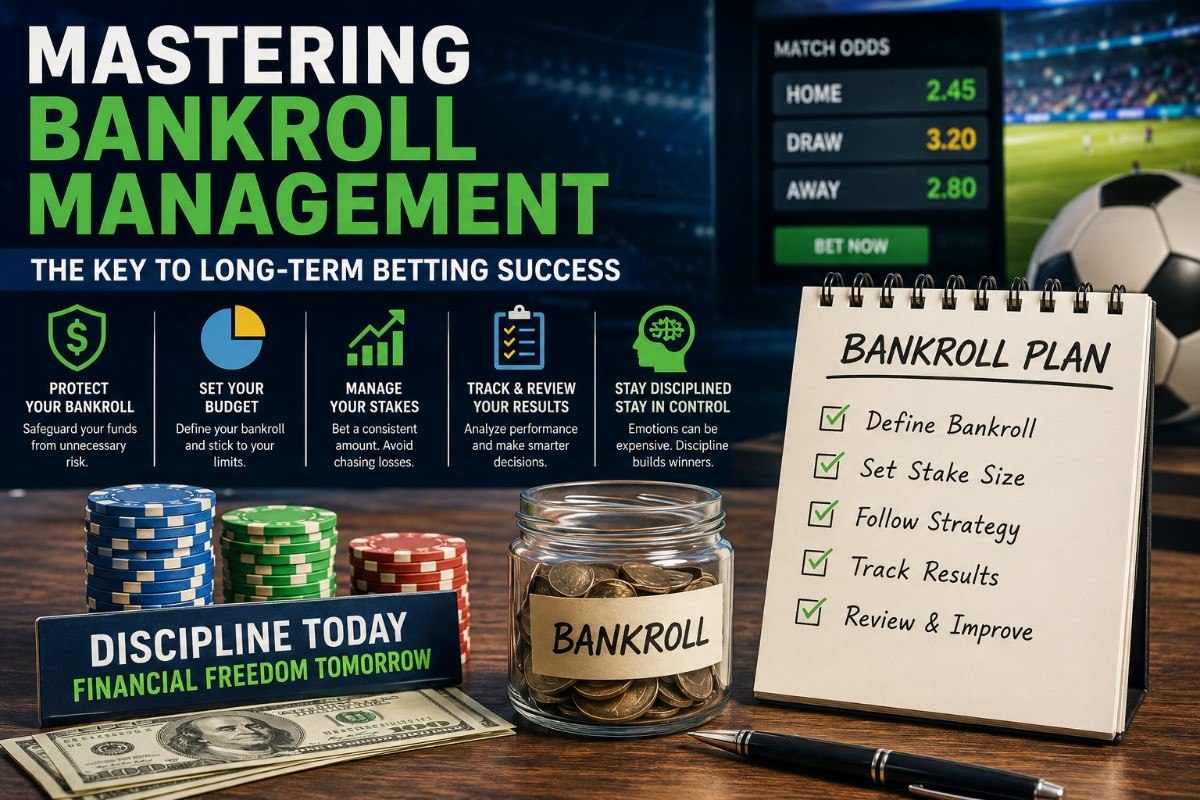
The Powerful Foundation of Smarter Betting
Bankroll management is one of the most important skills a bettor can develop. While odds, statistics, team analysis, and market knowledge all matter, poor money management can quickly undermine even the strongest betting strategy.
Mastering bankroll management for long-term betting success is not about guaranteeing profits. No betting system can remove uncertainty or guarantee that a bettor will win. Instead, effective bankroll management helps control exposure, reduce the impact of losing streaks, and create a more disciplined decision-making process.
A bankroll is the amount of money a person has specifically set aside for betting. It should be separate from essential funds needed for rent, food, bills, debt payments, savings, or other financial responsibilities. This simple boundary is a powerful first step toward responsible participation.
At its core, bankroll management for long-term betting success is about survival, consistency, discipline, and control. The goal is not to chase one dramatic win. The goal is to make decisions that remain sensible over many bets.
This guide was created as an educational resource using established principles from probability, risk management, behavioral science, and responsible gambling guidance. It is intended to help readers understand how disciplined stake sizing and emotional control can support safer and more informed betting decisions.
What Is Bankroll Management?
Bankroll management is the process of deciding how much money to allocate to betting and how much of that bankroll to risk on an individual wager.
For example, imagine a bettor has decided that their total betting bankroll is $1,000. They must then decide how much of that amount is appropriate to risk on each bet.
The key question is not:
“How much can I win?”
A more useful question is:
“How much can I reasonably risk without one result seriously damaging my entire bankroll?”
That change in thinking can transform the betting experience.
Strong bankroll management for long-term betting success focuses on protecting capital. A bettor who risks too much on a single event can experience a major setback from one unpredictable outcome. A bettor who uses smaller, consistent stakes can better withstand normal fluctuations.
Probability does not guarantee that the better prediction will always win. Even a strategy with a theoretical advantage can experience losing streaks. This is why risk control matters.
Why Bankroll Management Matters So Much
Betting outcomes are uncertain. A carefully researched selection can lose because of injury, weather, a late mistake, unexpected performance, or simple randomness.
This uncertainty creates variance.
Variance refers to the natural fluctuations in results. A bettor may make several correct decisions and still experience losses in the short term. Likewise, a bettor may win several bets without necessarily having a sustainable advantage.
Without a structured bankroll management plan, short-term emotions can take control.
Common mistakes include:
- Increasing stakes after a loss
- Betting more to recover money quickly
- Treating a winning streak as proof that risk no longer matters
- Using money intended for essential expenses
- Making impulsive bets because an event feels exciting
- Changing stake sizes based purely on confidence or emotion
A disciplined approach creates a barrier between emotion and action.
That is the real strength of bankroll management for long-term betting success: it encourages decisions to be made according to a plan rather than the excitement or frustration of a single result.
Step One: Create a Dedicated Betting Bankroll
The first rule is simple and essential:
Only use money you can afford to lose.
A betting bankroll should be separate from everyday finances. Do not treat betting funds as money needed for necessities or as a guaranteed source of income.
Before placing any wager, determine a fixed bankroll amount.
For example:
- Total bankroll: $500
- Betting funds are separate from household expenses
- The amount is reviewed according to a planned schedule
- Additional deposits are not made impulsively to chase losses
This structure creates clarity.
When the bankroll reaches a predetermined limit, the betting activity stops. That boundary can help prevent emotional decisions during difficult periods.
Responsible bankroll management is not a strategy for making losses disappear. It is a framework for limiting financial exposure.
Step Two: Use Units Instead of Random Bet Sizes
One of the clearest methods for bankroll management for long-term betting success is the unit system.
A unit is a fixed percentage or carefully selected portion of the total bankroll.
For example, a bettor with a $1,000 bankroll might define one unit as 1% of the bankroll.
In this example:
- Bankroll: $1,000
- One unit: $10
- Standard bet: 1 unit
- Higher-confidence bet: perhaps 1.5 or 2 units, if permitted by the bettor’s pre-established rules
The exact percentages can vary. The most important factor is consistency.
The unit system helps prevent a common mistake: dramatically increasing stakes simply because a bettor feels certain about an outcome.
Confidence is not the same as certainty.
Every betting decision contains uncertainty, and even highly experienced analysts can be wrong. A unit-based approach provides a repeatable structure that does not depend entirely on emotion.
The Golden Principle: Risk Small Enough to Survive Variance
A dramatic winning opportunity can feel irresistible. However, risking a large percentage of a bankroll on one event creates a serious problem.
If the bet loses, recovering becomes much harder.
Consider two bettors.
Bettor A risks 50% of their bankroll on one wager.
Bettor B risks 1% to 2% of their bankroll on individual wagers according to a consistent plan.
A single loss can severely damage Bettor A’s ability to continue. Bettor B, while still experiencing losses, has greater protection against individual results.
This is why preservation is powerful.
You do not need every bet to win to understand the value of discipline. The ability to withstand normal losing periods is an important part of any long-term risk-management approach.
Protect the bankroll first. Opportunity comes second.
Flat Betting: A Simple and Reliable Starting Point
Flat betting means using the same stake size on most or all wagers.
For example:
- Bankroll: $1,000
- Standard stake: $10
- Every qualifying bet: $10
This method is easy to understand and easy to monitor.
Its greatest strength is consistency.
Flat betting reduces the temptation to suddenly double or triple a stake after a loss. It also prevents a bettor from becoming overly aggressive after a winning streak.
For beginners, a simple flat-staking plan can be easier to follow than a complicated system.
Complexity does not automatically create better decisions.
Sometimes the most powerful strategy is the one that remains easy to follow when emotions are high.
Percentage-Based Betting: Adjusting as the Bankroll Changes
Another approach is to calculate stake size as a percentage of the current bankroll.
Suppose a bettor risks 1% per standard wager.
If the bankroll is:
- $1,000, the stake is $10
- $900, the stake becomes $9
- $1,100, the stake becomes $11
This method naturally adjusts exposure.
After losses, stake sizes become smaller. After growth, stake sizes can increase gradually.
The advantage is that the system responds to changes in the bankroll without requiring emotional decisions.
However, consistency remains important. Constantly changing the percentage or creating exceptions after losses defeats the purpose of the system.
For bankroll management for long-term betting success, the chosen method matters less than the discipline used to follow it.
Why Chasing Losses Can Be So Dangerous
One of the most destructive betting behaviors is loss chasing.
A bettor loses $50 and immediately thinks:
“I need to win it back right now.”
This mindset can lead to larger bets, weaker analysis, and rushed decisions.
Behavioral science has repeatedly shown that people do not always make perfectly rational decisions when facing losses, uncertainty, or strong emotions. Losses can create pressure to take additional risks.
A strong bankroll plan provides a pre-commitment.
Instead of deciding what to do while frustrated, the bettor follows rules created during a calm moment.
For example:
- Maximum stake is predetermined
- Daily or weekly loss limits are established
- Losing does not automatically increase the next stake
- A break is taken when emotional control is reduced
This creates distance between a negative result and the next decision.
Never let urgency become your betting strategy.
Track Every Bet for Greater Clarity
Accurate record keeping can reveal patterns that memory often misses.
A useful betting record may include:
- Date
- Event or market
- Odds
- Stake
- Result
- Profit or loss
- Reason for the selection
- Notes about the decision-making process
The goal is not simply to celebrate wins.
The goal is to learn.
A betting history can help identify questions such as:
- Are certain markets consistently performing poorly?
- Are stakes becoming larger after losses?
- Are decisions being made impulsively?
- Is a strategy being followed consistently?
- Are records showing results that differ from expectations?
This information can support more objective evaluation.
Strong bankroll management for long-term betting success requires measurement. Without records, it is easy to remember the biggest wins and forget the smaller losses that gradually reduce a bankroll.
Data creates perspective.
Separate Confidence From Stake Size
A common trap is believing that a strong opinion should automatically justify a huge bet.
But confidence can be influenced by:
- Recent wins
- Personal loyalty to a team or player
- Social media discussions
- Excitement around a major event
- Fear of missing out
- Selective attention to information supporting an existing belief
A disciplined bettor recognizes that feeling confident does not eliminate uncertainty.
Before increasing a stake, ask:
“Would this stake size still fit my written bankroll rules if the bet loses?”
If the answer is no, the stake may be driven by emotion rather than a sustainable process.
A powerful betting framework is built before the event begins.
Set Clear Loss Limits and Time Limits
Financial limits are important, but time limits can also support better decisions.
Long betting sessions may increase fatigue and reduce attention. Emotional reactions can become stronger after repeated wins or losses.
Consider establishing personal boundaries such as:
- A maximum amount to risk per day
- A maximum amount to risk per week
- A maximum number of bets in a session
- A scheduled break after a significant loss
- A rule against betting when tired, angry, stressed, or impaired
These limits are not signs of weakness.
They are signs of control.
The strongest decision is sometimes the decision not to place another bet.
Avoid the Illusion of Guaranteed Recovery
There is no universal betting system that can guarantee recovery from losses.
Systems that rely on continuously increasing stakes after losing can become particularly dangerous because eventually a losing streak may require a stake that is too large for the available bankroll.
Mathematics and probability do not guarantee that a win will arrive before financial limits are reached.
This is why disciplined stake sizing is more sustainable than aggressive recovery strategies.
A loss should be treated as part of the possibility of betting, not as a debt that must immediately be repaid.
Build a Powerful Pre-Bet Checklist
Before placing a wager, pause and ask:
- Does this bet fit my bankroll rules?
- Is the stake size predetermined?
- Can I afford to lose this amount?
- Am I making this decision emotionally?
- Have I reviewed the relevant information objectively?
- Am I trying to recover a previous loss?
- Would I still place this bet if the previous result had been different?
If several answers raise concerns, stepping away may be the best choice.
This short pause can be incredibly powerful.
A few seconds of reflection may prevent a decision that creates unnecessary risk.
How Bankroll Management Supports Long-Term Thinking
The phrase bankroll management for long-term betting success should not be misunderstood as a promise of guaranteed profit.
Long-term success depends on many factors, including the quality of decisions, the odds available, the size of any genuine advantage, costs, variance, and luck.
Bankroll management cannot turn a negative-expectation activity into a guaranteed winning one.
What it can do is help manage risk.
It encourages bettors to:
- Protect available funds
- Reduce emotional decision-making
- Create consistent stake sizes
- Track performance
- Respect uncertainty
- Set clear boundaries
- Avoid catastrophic exposure to a single outcome
That is a far more realistic and trustworthy goal.
A Simple Bankroll Management Framework
Here is a straightforward example:
1. Define Your Bankroll
Choose an amount specifically allocated to betting and separate it from essential finances.
2. Select a Unit
Choose a small, manageable portion of the bankroll as one unit.
3. Set Standard Stakes
Use a consistent number of units for normal wagers.
4. Create Maximum Limits
Decide in advance how much can be risked during a specific period.
5. Record Every Decision
Track bets honestly, including both wins and losses.
6. Review, Don’t React
Evaluate performance over a meaningful sample rather than changing the entire strategy after one or two results.
7. Protect Emotional Control
Take breaks when betting stops feeling controlled or enjoyable.
This framework is simple, but simplicity can be a major advantage.
Trust, Transparency, and Responsible Information
This educational content is designed to help readers understand risk management rather than promote unrealistic promises.
Any trustworthy betting resource should be transparent about an important fact:
Betting involves financial risk, and losses are always possible.
There is no expert analysis, algorithm, prediction model, or staking system that can guarantee a winning result.
Readers should also verify the legality and age requirements for betting in their location and use appropriately licensed services where betting is legal.
A trustworthy platform should prioritize clear information, responsible participation, secure technology, privacy protection, and transparent policies.
For readers seeking educational betting information, https://www.into88.info/ should present content with a clear editorial purpose, distinguish educational material from promotional claims, and avoid suggesting guaranteed outcomes.
About the Editorial Approach
This article was produced as an educational guide focused on the practical principles of risk management, probability, behavioral decision-making, and responsible betting.
The content is designed to be reviewed and maintained by writers or editors with relevant knowledge of betting markets, probability, statistics, financial risk concepts, and responsible gambling practices.
The purpose is not to encourage excessive betting or promise financial success. Its purpose is to help readers understand why structured bankroll management can be more valuable than impulsive decision-making.
Expertise requires more than making bold predictions.
It requires acknowledging uncertainty.
Authoritativeness requires evidence-based reasoning.
Trustworthiness requires transparency about risk.
Those principles guide this approach to bankroll management for long-term betting success.
Frequently Asked Questions About Bankroll Management
What is bankroll management in betting?
Bankroll management is the process of deciding how much money is allocated to betting and determining how much of that bankroll can be risked on individual wagers. Its main purpose is to control financial exposure and support consistent decision-making.
What percentage of my bankroll should I bet?
There is no universal percentage that is appropriate for everyone. The suitable amount depends on personal finances, risk tolerance, and betting objectives. A conservative approach generally focuses on risking only a small portion of a dedicated bankroll rather than placing a large share on one outcome.
Can bankroll management guarantee long-term betting success?
No. Bankroll management cannot guarantee profits or eliminate losses. It is a risk-management tool that can help limit exposure and improve consistency.
Should I increase my stake after losing?
Increasing stakes purely to recover losses can increase risk and encourage emotional decision-making. A predefined staking plan can help prevent impulsive changes.
Is it better to use flat betting or percentage-based staking?
Both approaches can support discipline. Flat betting uses a consistent stake, while percentage-based staking adjusts the amount as the bankroll changes. The most suitable approach is one that is understood clearly and followed consistently.
Why is tracking betting results important?
Tracking provides a more accurate picture of performance. It can help identify patterns, reveal emotional decisions, and show whether a betting process is actually being followed.
How do I know when to stop betting?
A bettor should establish personal financial and time limits in advance. If betting is causing financial pressure, emotional distress, or difficulty controlling spending, stopping and seeking appropriate support is an important step.
Final Thoughts: Discipline Is the Real Competitive Advantage
The excitement of betting can make it tempting to focus entirely on the next result. But long-term thinking requires a different mindset.
A single win does not prove a strategy.
A single loss does not necessarily prove a strategy is worthless.
What matters is the quality and consistency of decisions over time.
Bankroll management for long-term betting success is ultimately about discipline, patience, protection, and control. It helps transform betting from a series of emotional reactions into a structured process with clear boundaries.
Start with a dedicated bankroll. Define your unit. Keep stakes under control. Track every result. Respect uncertainty. Never chase losses. Review your decisions honestly.
The most powerful move is not always placing a bigger bet.
Sometimes it is protecting the ability to make a better decision tomorrow.